
Management intelligence for healthcare
Understand your HMO’s financial position.
See what needs attention.
Stratum is developing management intelligence to help HMO leaders understand plan economics, cost pressure and the evidence behind changes.
Connect the financial position with membership, service patterns and the records that support the explanation.
Current demonstration: synthetic HMO data and fictional organisations.
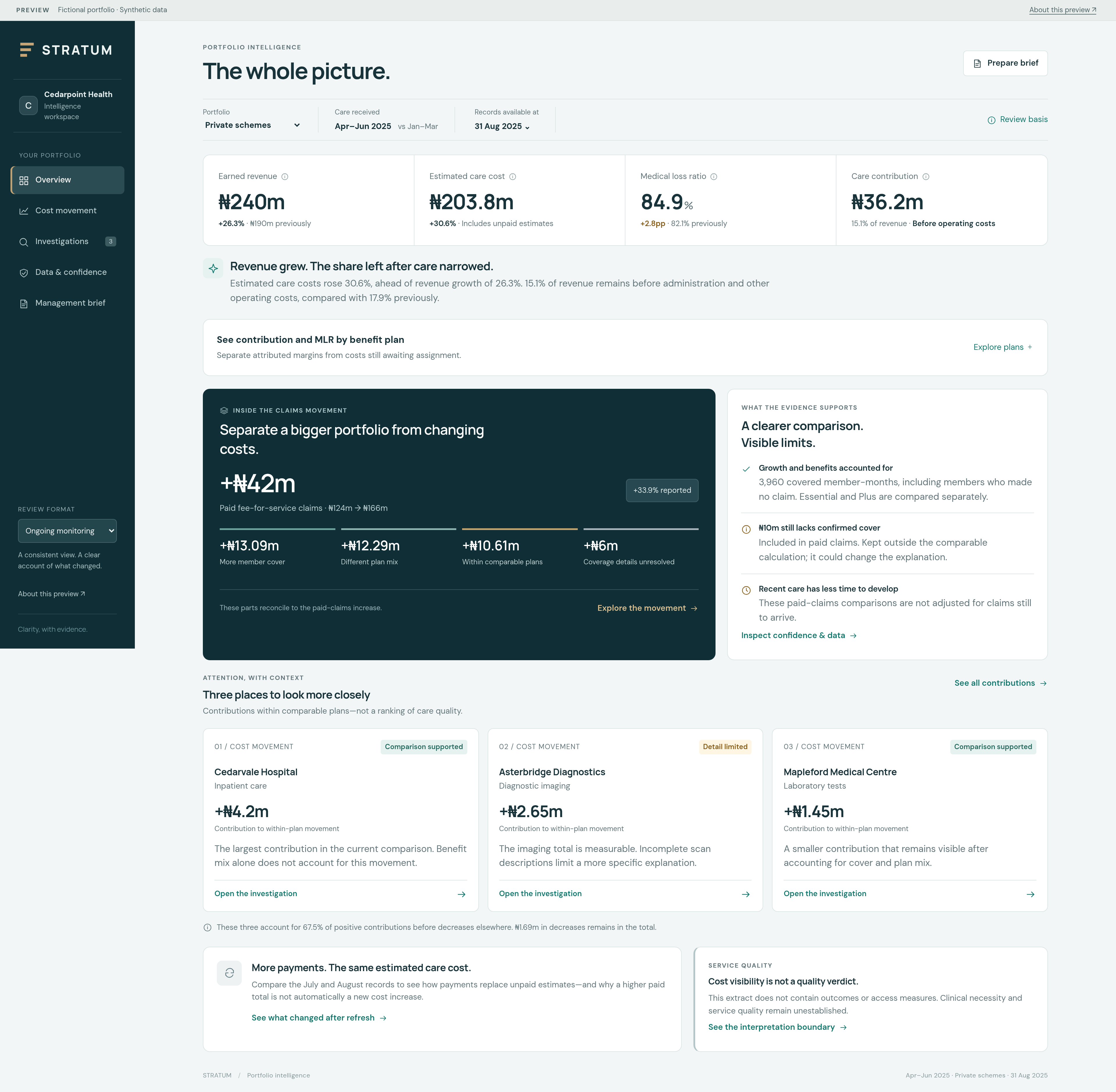
In this example, estimated care costs grew 30.6% while revenue grew 26.3%. The share remaining before operating costs fell from 17.9% to 15.1%.
The HMO management view
See the connected financial picture.
Plans, membership, care costs, providers and services belong in the same management discussion.
Plan economics
Compare revenue, estimated care costs and contribution across plans, with payment arrangements in view.
Membership
Keep enrolment and plan-mix movement visible so the basis for comparison is clear.
Care costs
Examine the components of cost movement and distinguish the period of care from the timing of records and payments.
Providers and services
See where movement is concentrated and which areas the available detail supports investigating.
Why the comparison matters
More paid claims. Has care cost increased?
In this synthetic example, later settlements increase paid claims by ₦8m while the estimated cost of the same care period stays unchanged.
| Measure | Records at 31 July | Records at 31 August |
|---|---|---|
| Paid fee-for-service claims | 158.0 | 166.0 |
| Reported outstanding FFS | 13.0 | 10.0 |
| Estimated unreported FFS | 13.0 | 8.0 |
| Accrued capitation | 19.8 | 19.8 |
| Estimated incurred care cost | 203.8 | 203.8 |
FFS = fee-for-service. The total includes paid claims, outstanding and unreported estimates, and accrued capitation.
A different interpretation of the movement.
Reading the payment total on its own could suggest additional care cost. The Finance comparison shows that later payments replace unpaid estimates in this example.
Supported: the recorded paid amount increased; estimated incurred care cost remained ₦203.8m.
Still open: ultimate claims completion and explanations requiring missing cover or clinical context. These figures do not establish an actuarial reserve.
Inside Stratum Intelligence
Follow the finding into the evidence.
The financial view leads into a connected investigation: understand the comparison, examine what supports it, and bring the current account into management review.
01 / Financial position
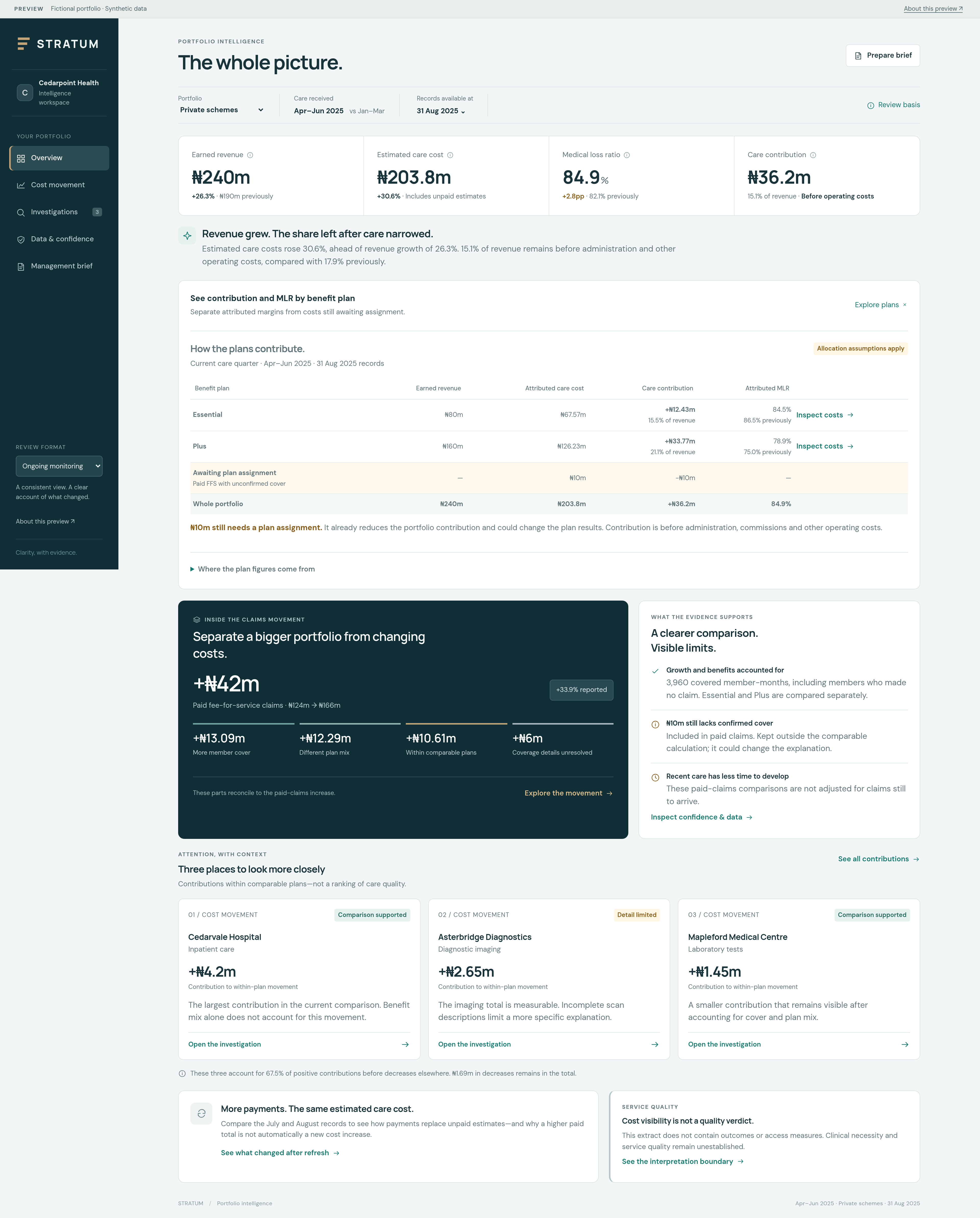
Understand the plans behind the total.
Compare the plans shown with their income, care costs, membership and payment arrangements in context. Care contribution is shown before operating costs.
02 / Questions and evidence
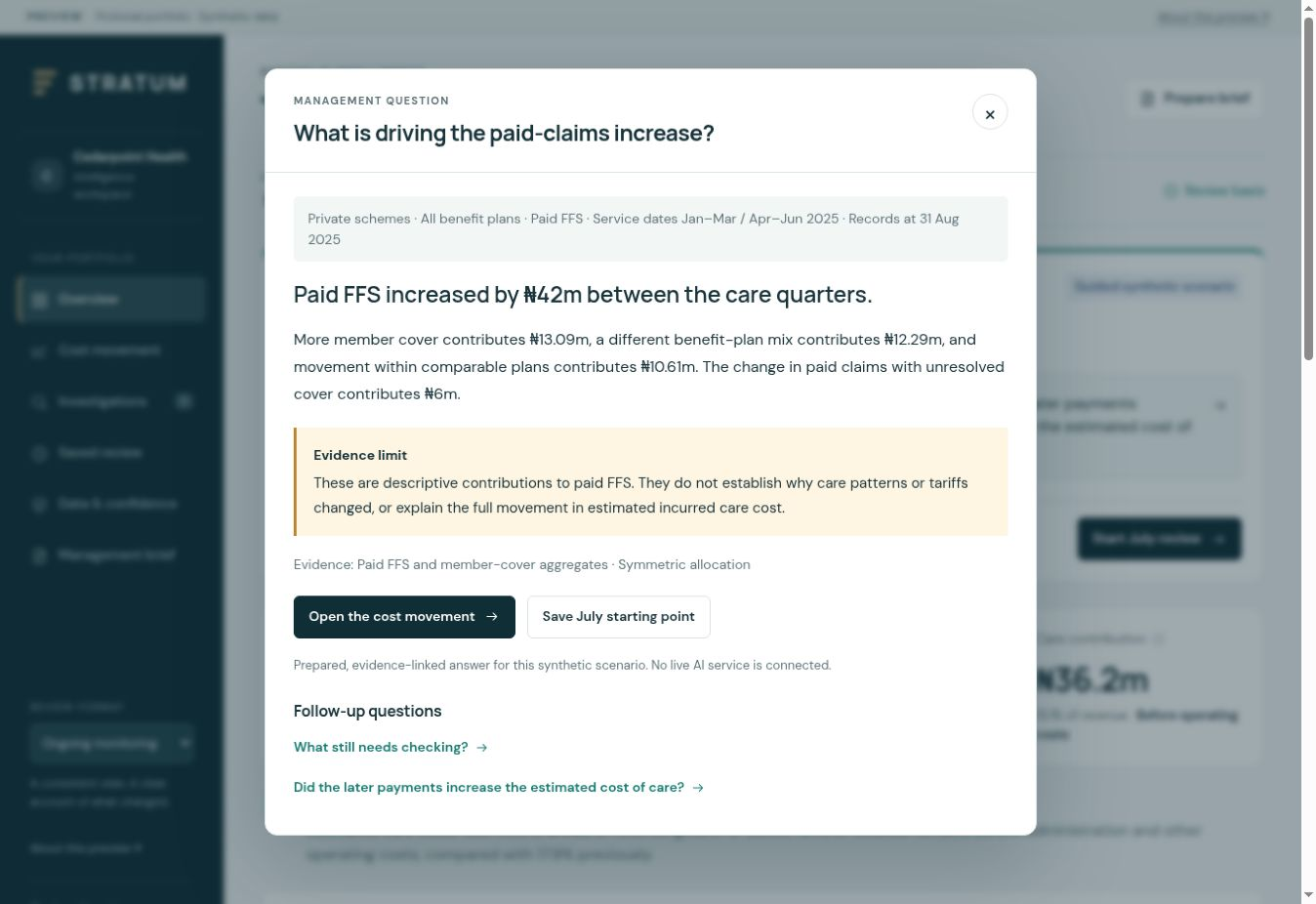
Keep the answer connected to its basis.
The prepared questions illustrate how a management concern connects to its comparison, supporting evidence and interpretation limits.
03 / Investigation
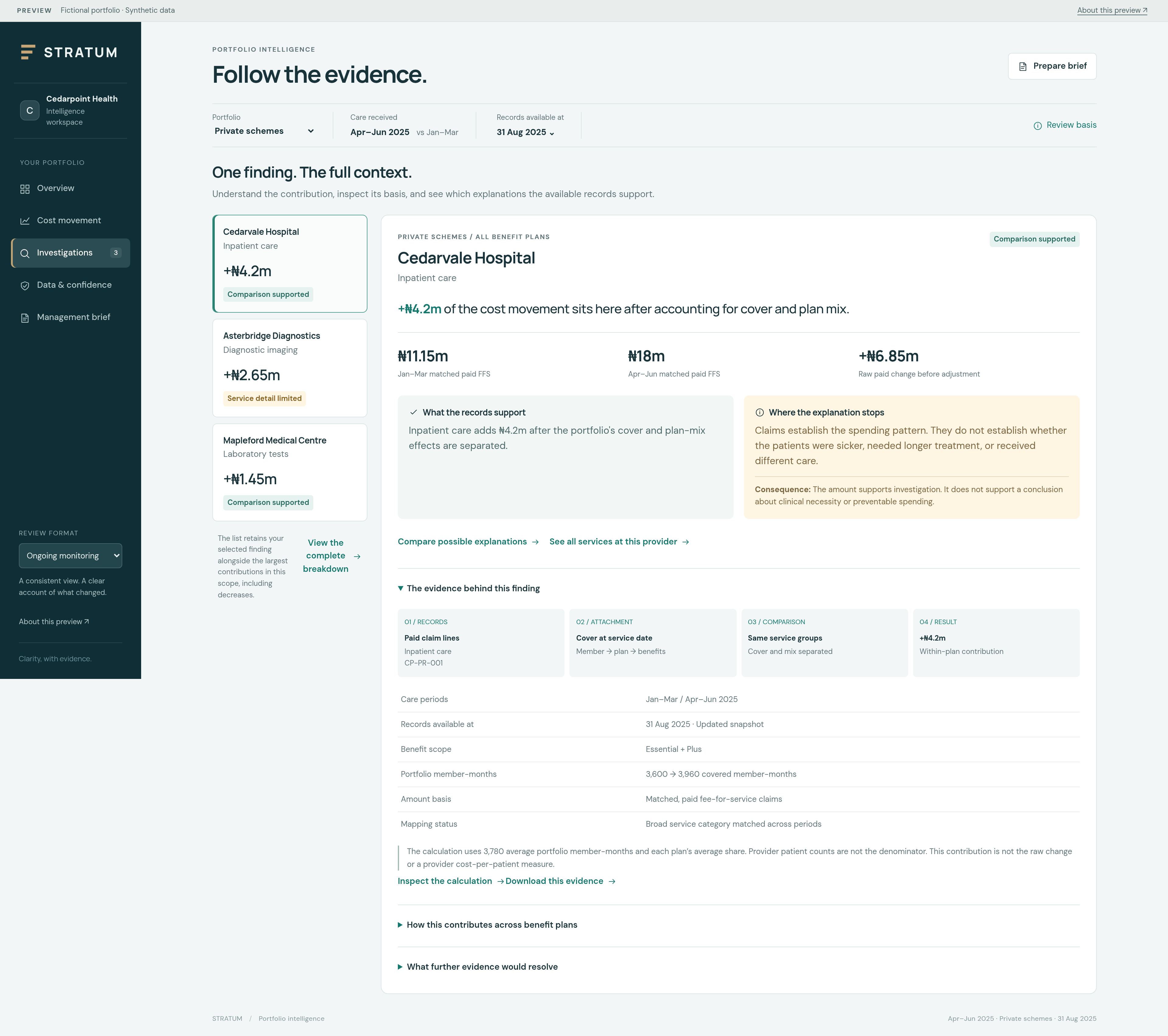
Know how far the records support an explanation.
Trace the movement into providers and service groups. Supported and detail-limited views make clear what can be examined and where additional evidence is needed.
04 / Management account
Bring findings and open checks into the brief.
The illustrative Finance contribution updates the management account while preserving the earlier finding and the questions that remain unresolved.
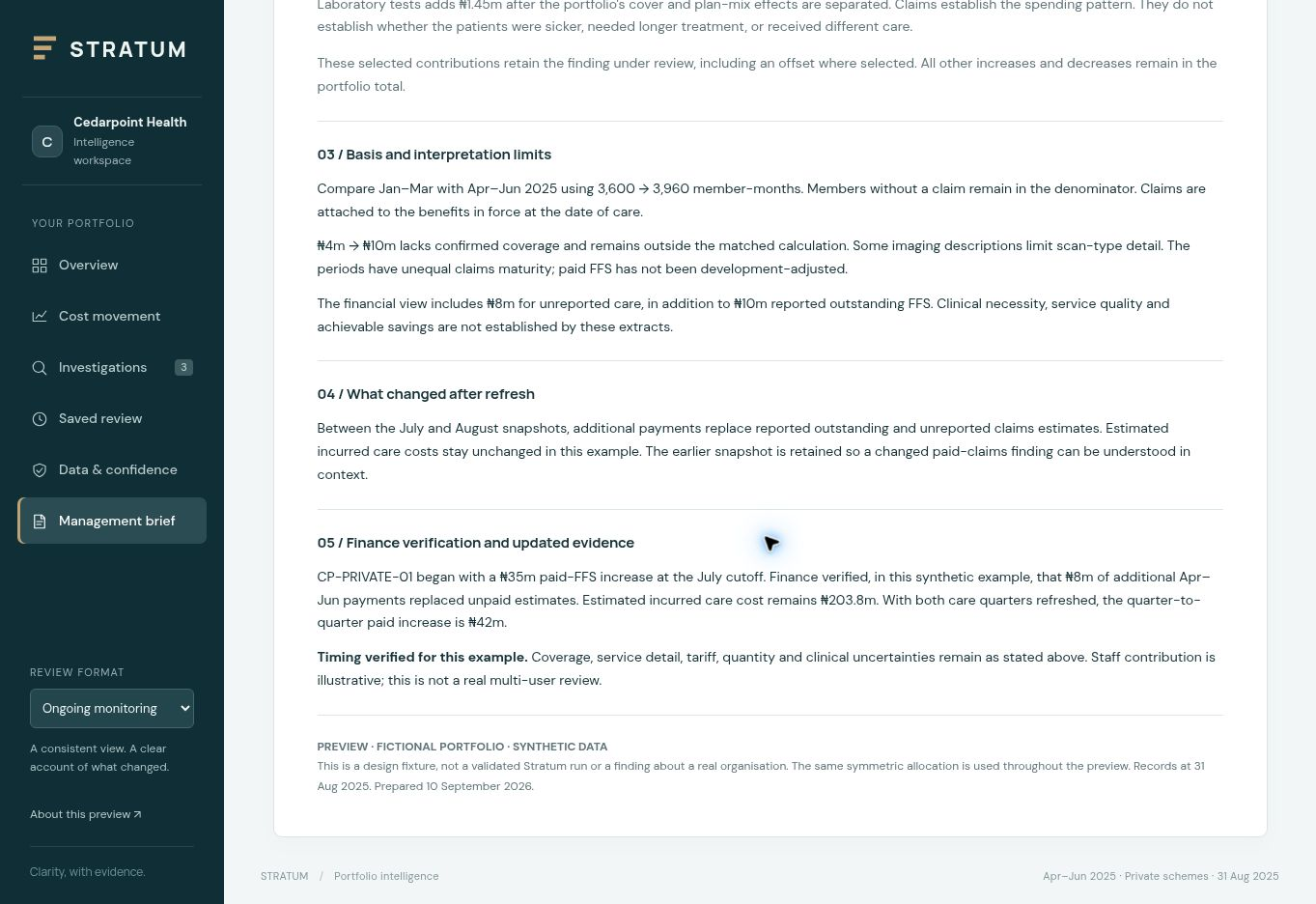
Intended implementation
A continuing view for management.
Stratum is being developed for recurring management use: revisit the position as records change, retain the basis of earlier findings, and carry open verification questions into the next review.
01
Review the current position
Refresh the agreed view using defined records, periods and organisational context.
02
Retain the earlier account
Keep the evidence and comparison basis behind previous findings available.
03
Carry open questions forward
See what new evidence resolves and what still needs verification.
04
Prepare the next discussion
Bring the current position and remaining questions into the management brief.
The synthetic preview illustrates this review journey. Production refreshes and a shared, persistent workspace are implementation work.
Working with your organisation
Build on the information you already have.
An initial implementation establishes the useful management scope, the available records and the comparisons your team can rely on.
Agree the useful view
Identify the concerns, comparisons and recurring management discussions the first implementation should support.
Check the records
Review the available sources, definitions, coverage and timing. Request more detail when it resolves a named uncertainty.
Establish repeatable use
Configure and validate the agreed outputs, then establish refresh responsibilities and the review cadence.
Across healthcare
A shared foundation.
Questions specific to each setting.
Our current demonstration focuses on HMOs. We are exploring how the same analytical foundation can support management visibility in pharmacies, hospitals and public health institutions, with each application developed and validated for its setting.
Current synthetic demonstration and implementation focus
HMOs and health insurers
Understand plan economics and cost movement with enrolment, payment arrangements and data limitations in view.
Discovery and validation
Multibranch pharmacies
We are examining management visibility needs across pharmacy branches, products and purchasing activity.
Potential application for discovery and adaptation
Private and public hospitals
Potential applications include service-line economics, payer mix, receivables and resource-use patterns. These would require hospital-specific development and validation.
Potential institutional application
Government agencies and health purchasers
Potential applications include spending and service-delivery visibility, programme comparisons and the evidence limitations that affect interpretation.
Evidence & trust
Confidence includes knowing the limits.
The current product preview uses synthetic data. Findings keep their comparison basis, supporting evidence and interpretation limits visible.
The company
Built around healthcare management questions.
Stratum combines healthcare experience and software engineering to develop a reusable foundation for management intelligence.
A management conversation
Start with what your team needs to see.
In a 30-minute walkthrough, explore the relevant parts of the HMO preview and discuss what would be needed to assess fit with your organisation’s records. No dataset is needed.