
Stratum Intelligence / Product preview
The financial position.
The evidence behind it.
Explore plan economics, membership and care-cost movement, then examine the evidence supporting the management account.
Synthetic HMO preview · Financial position, investigation and review
These are captured product screens using fictional organisations and synthetic figures. Begin with the financial position, then explore the prepared investigation and Finance review examples. Select any image to inspect it at full size.
01 / Portfolio overview
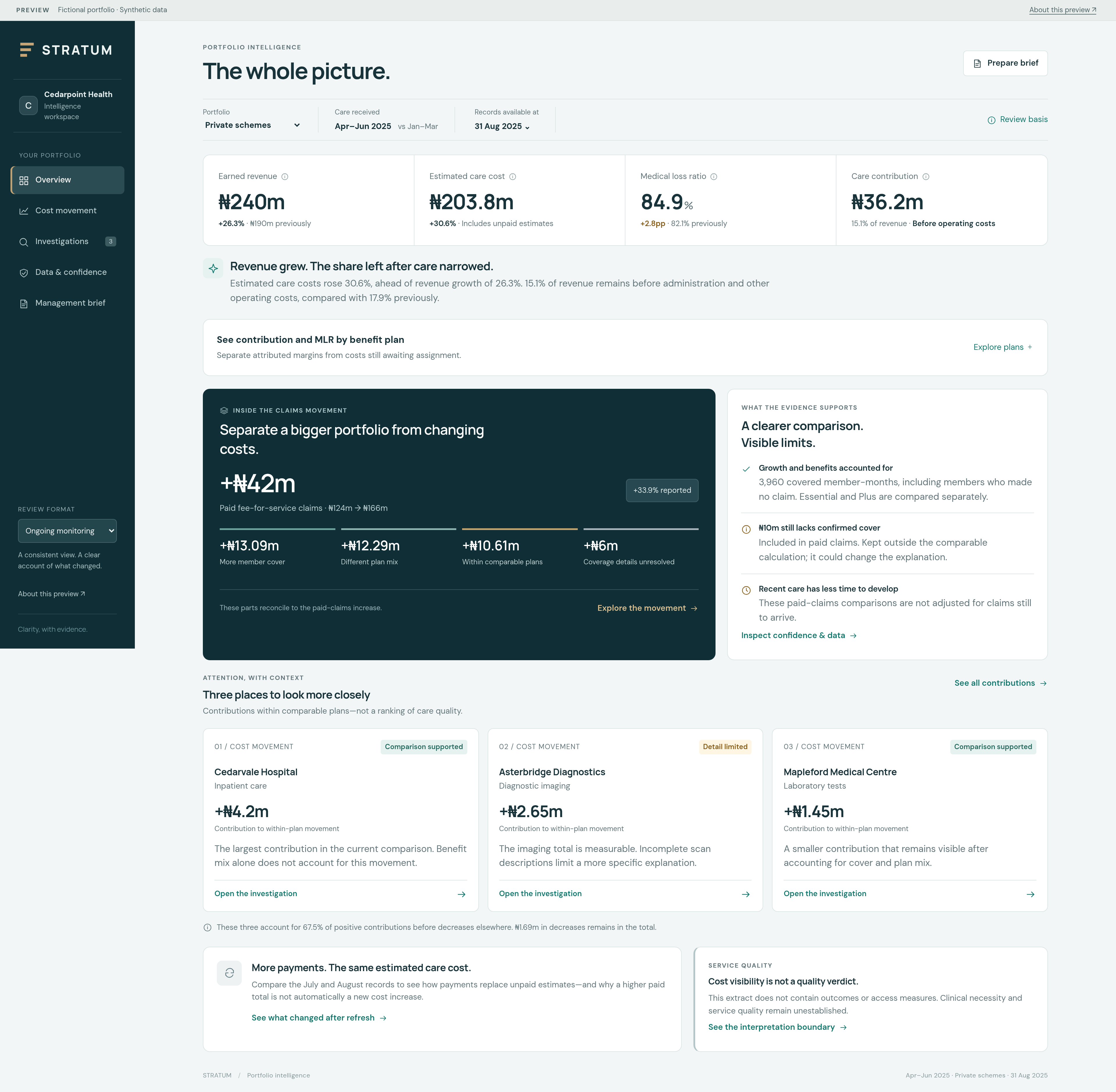
Revenue, care costs and the share remaining.
Read revenue, estimated care cost, medical loss ratio and care contribution together. In this example, care costs grew faster than revenue and the share remaining before operating costs narrowed.
Fictional organisations and synthetic figures. Care contribution is before operating costs.
02 / Benefit-plan economics
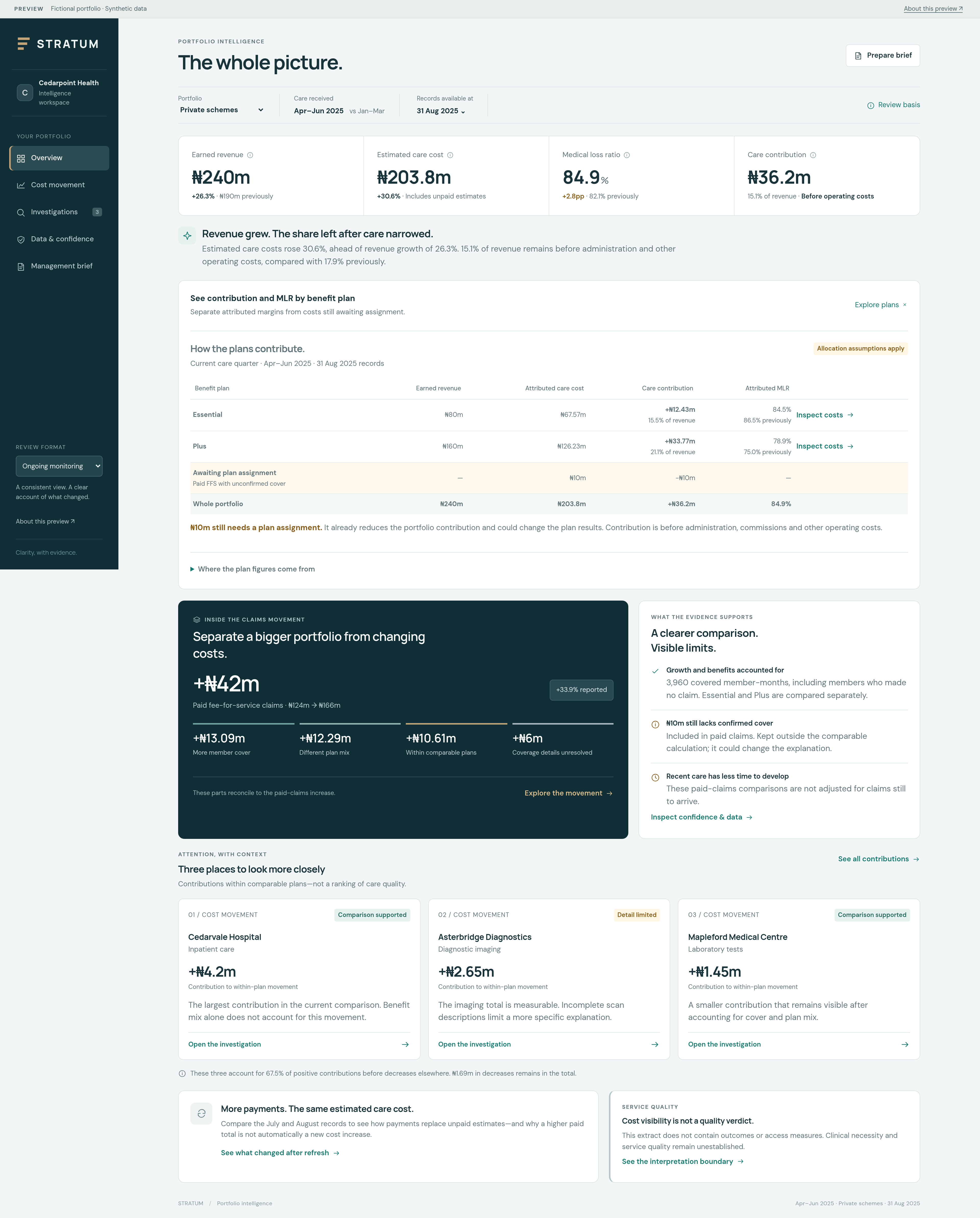
Which plans are under pressure?
Examine observed income and cost relationships with plan structure, enrolment and payment arrangements in context.
Care contribution is shown before operating costs. The preview separates recorded figures from estimates; it does not establish net profit, premium adequacy or reserve requirements.
03 / Cost movement
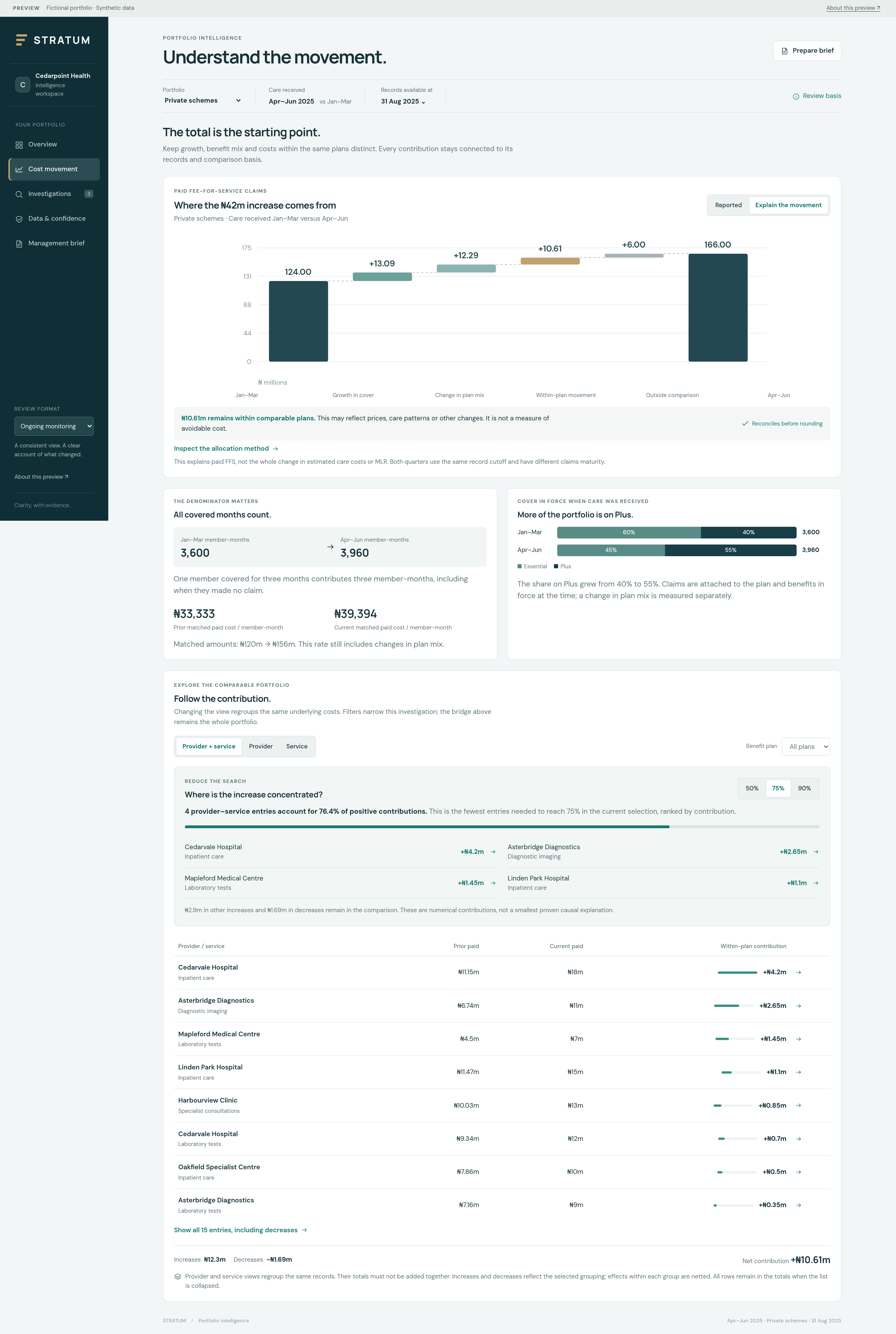
What contributes to the change?
Separate changes associated with cover and plan mix, then inspect the remaining contribution across providers and service groups. Keep the underlying comparison basis in view.
04 / Supported investigation
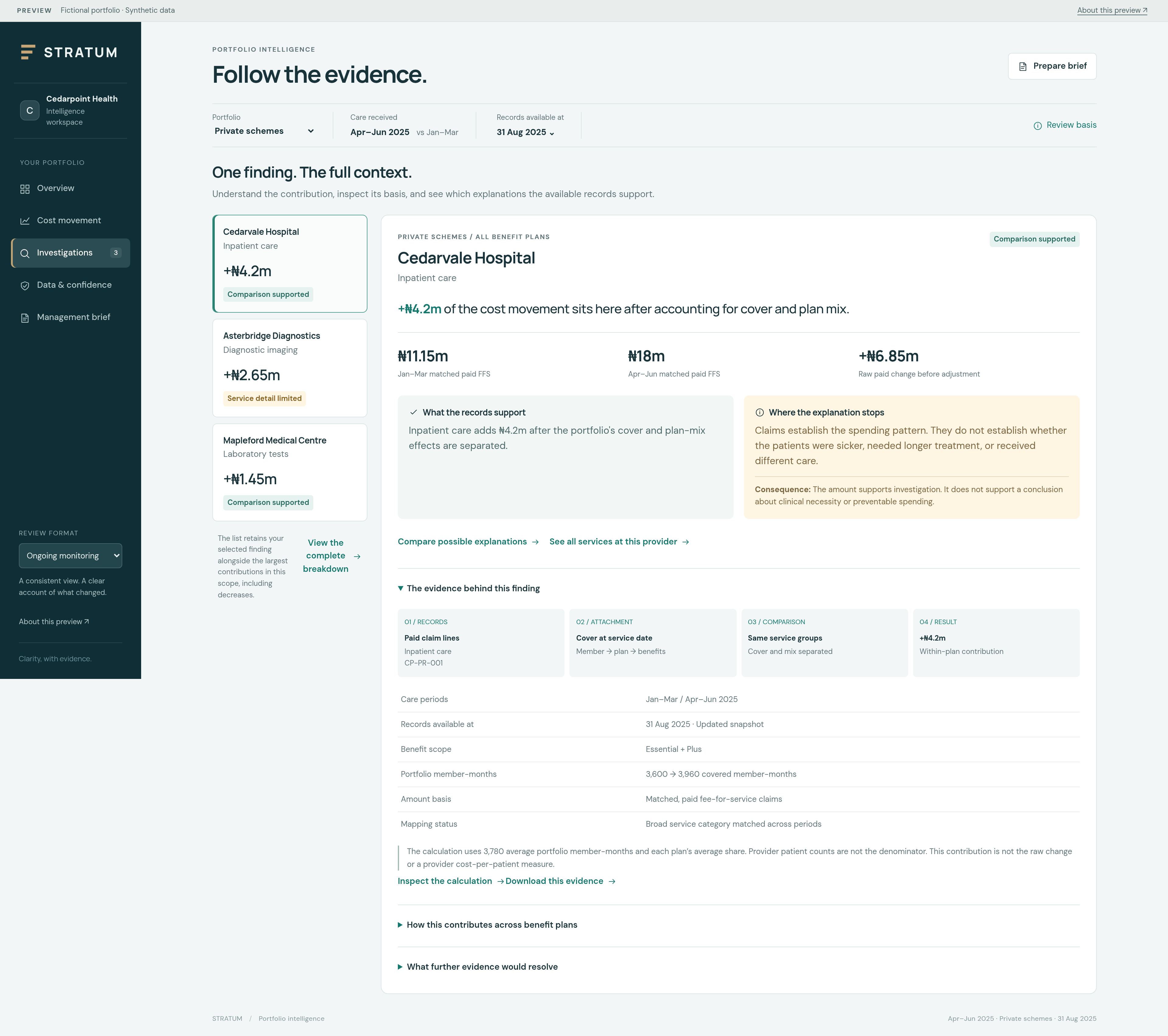
How far can we explain this movement?
Inspect a finding with sufficient detail for the demonstrated analytical step, including the evidence and conditions supporting the interpretation.
An observed contribution to cost movement does not, by itself, establish its underlying cause.
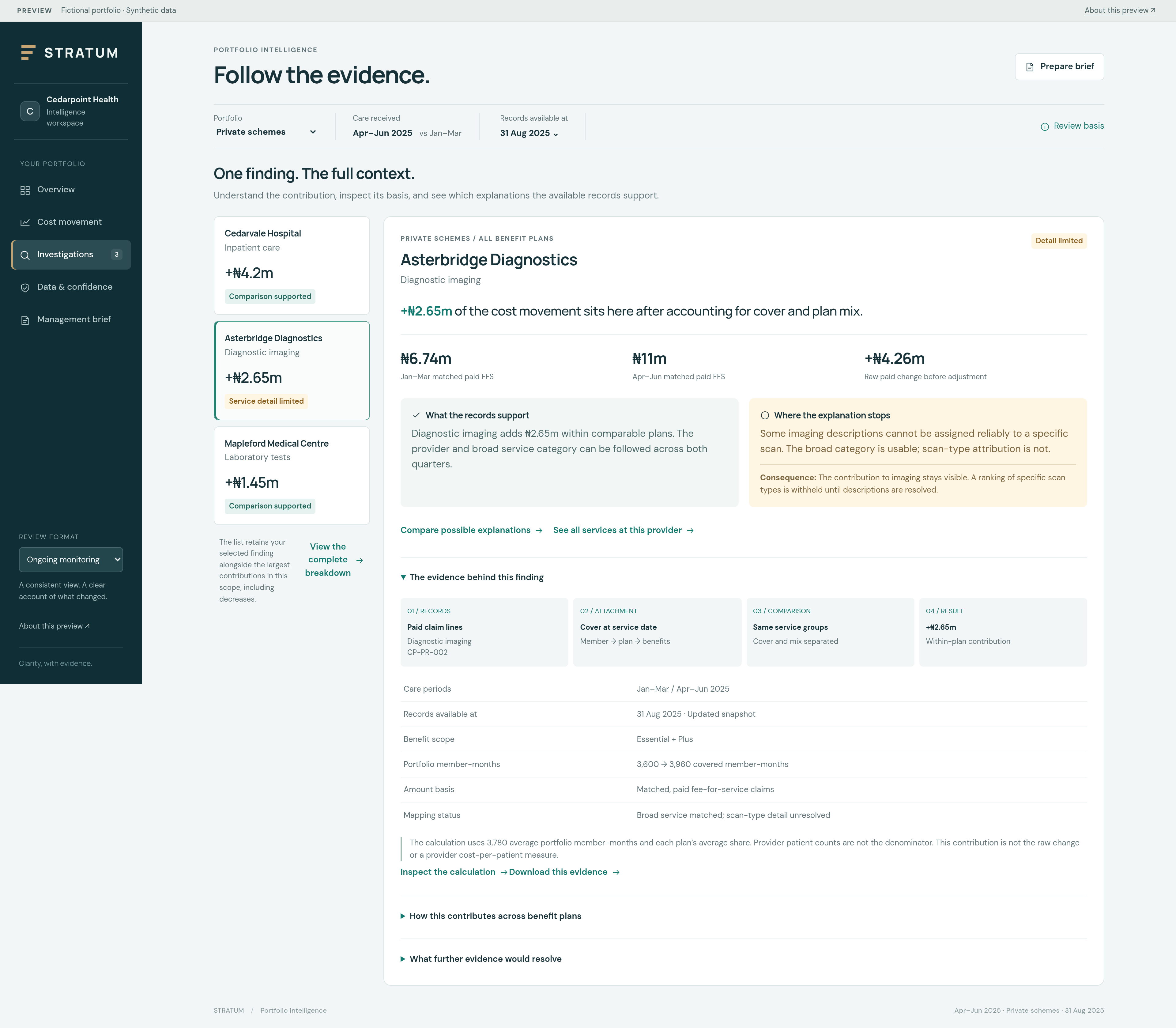
05 / Detail-limited investigation
What can we say when the detail is incomplete?
See where the evidence supports an observation but cannot support a deeper explanation. The view makes the missing detail and the resulting limit explicit.
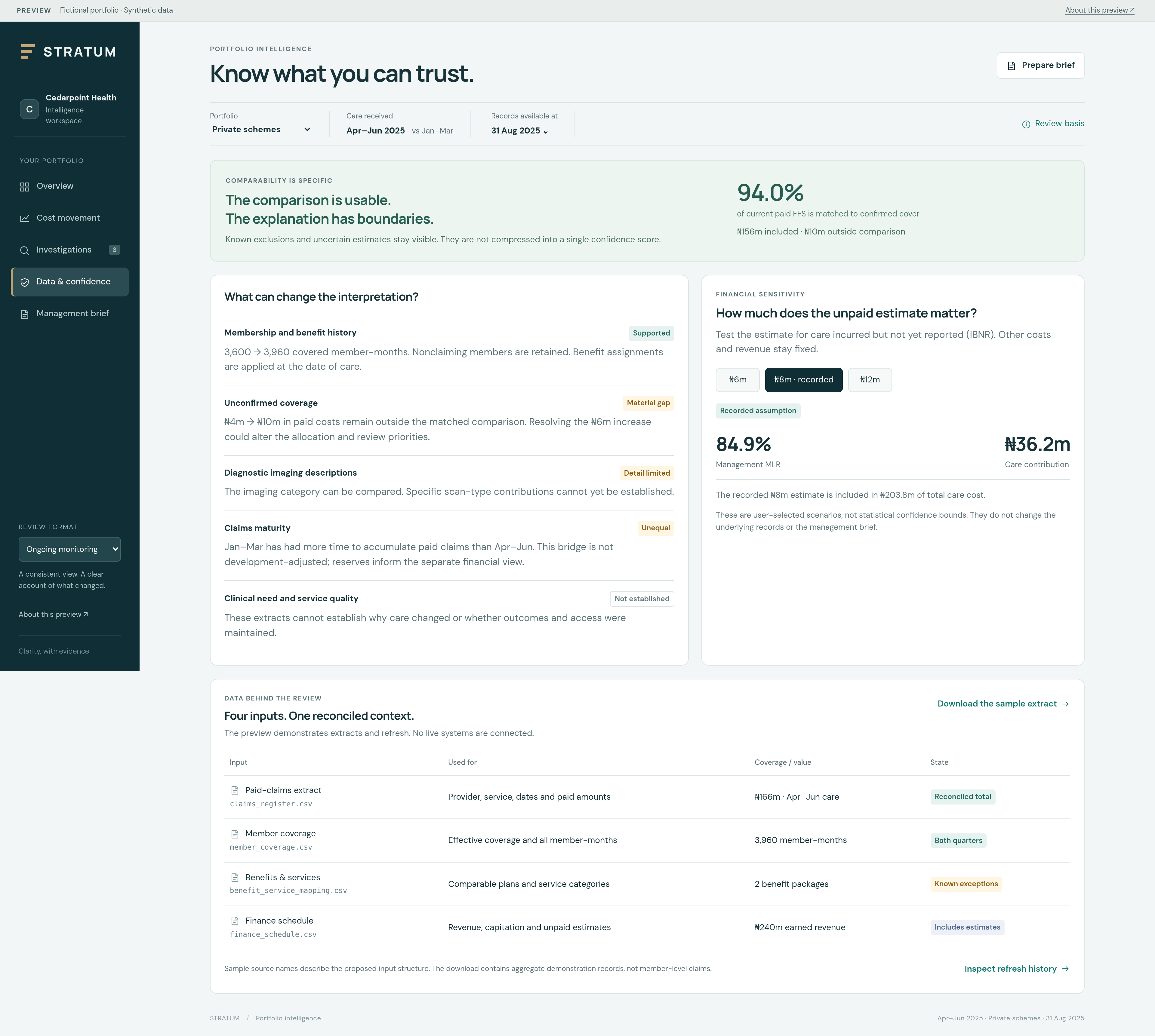
06 / Data & confidence
What affects our confidence in the result?
Review source coverage, comparison conditions and recorded assumptions, including estimates that affect the financial picture.
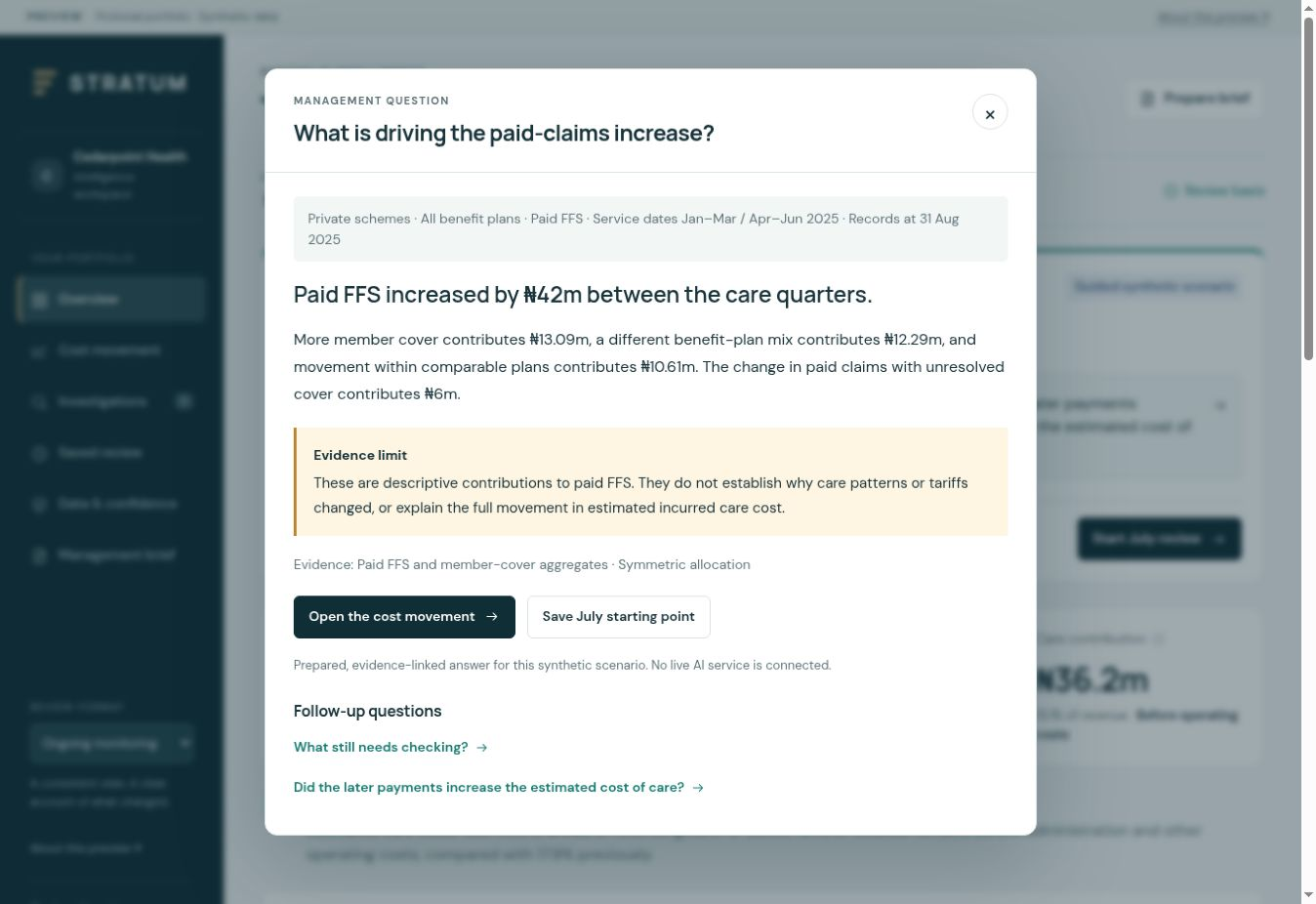
07 / Guided questions
Start with the question management is asking.
Choose a question about paid-claims growth, evidence still needed or the effect of later payments. Each prepared answer links to the relevant comparison and states its limits.
Prepared answers for the synthetic scenario. The examples illustrate how an answer stays connected to its evidence.
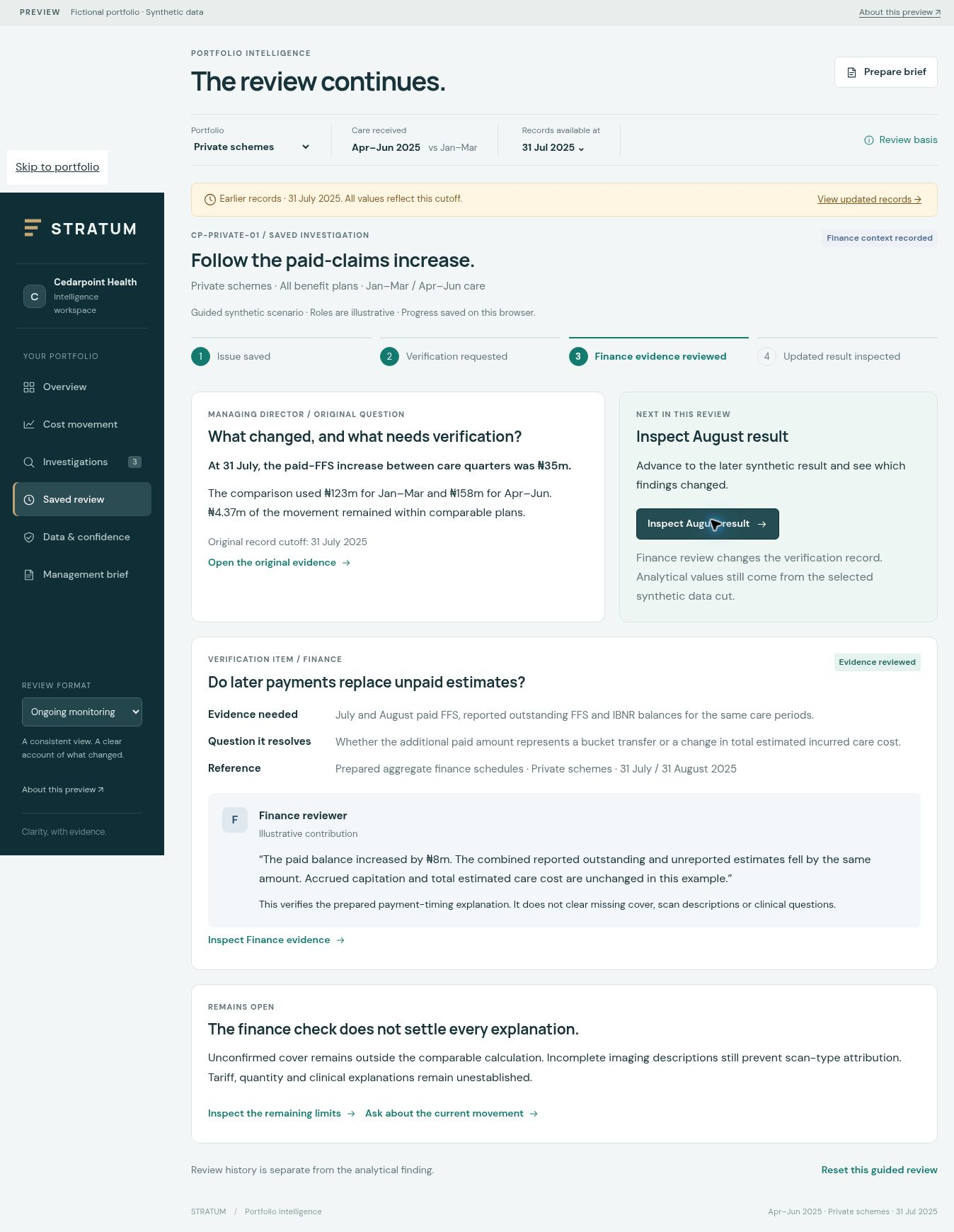
08 / Saved review
Carry one investigation through the review.
Save the July starting point, create an illustrative Finance verification item and inspect the August result. The original finding remains available, and unresolved explanations remain open.
Guided synthetic scenario with illustrative review roles and prepared contributions.
09 / Finance evidence
Separate later payments from a new cost increase.
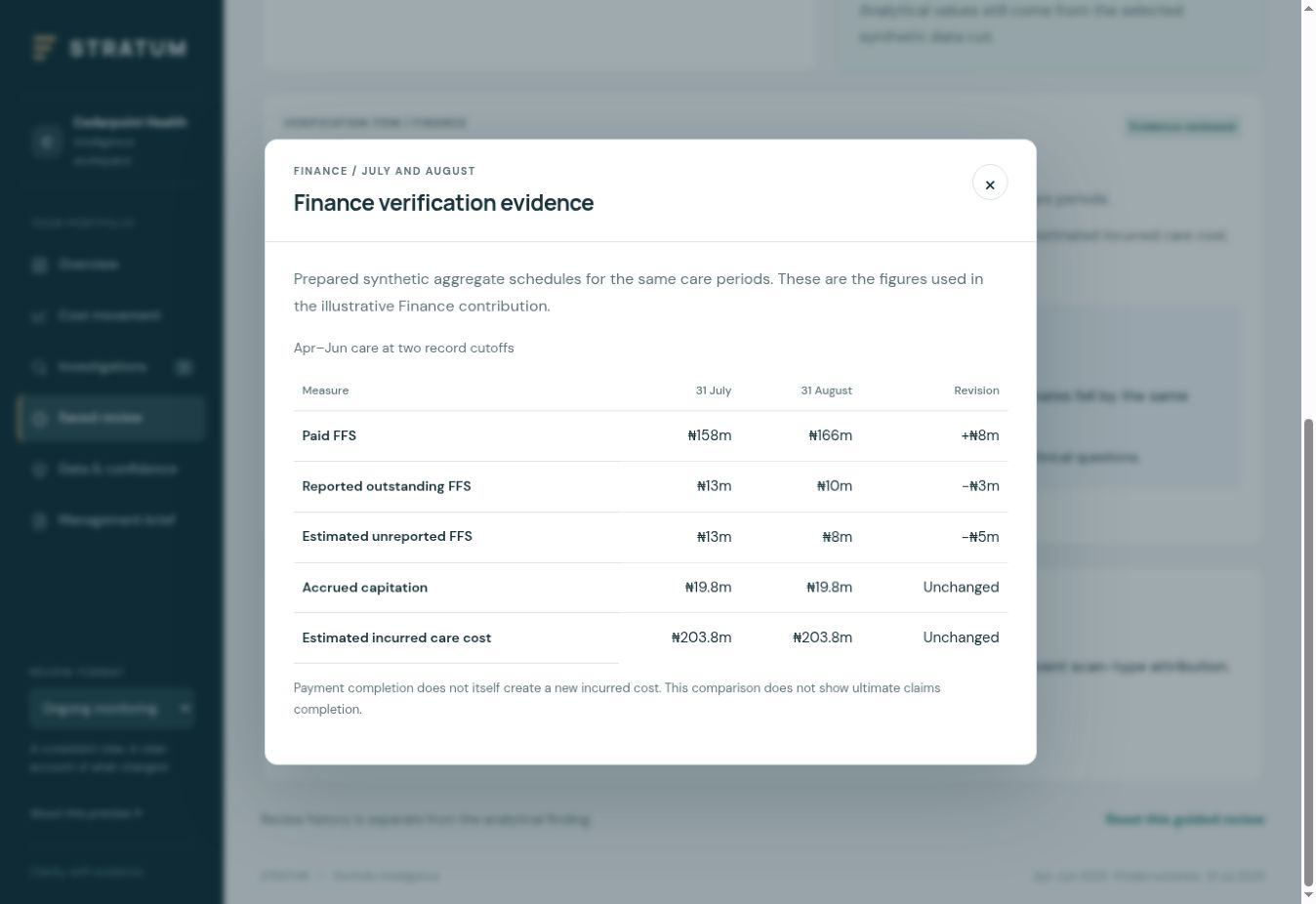
In this example, later payments replace unpaid estimates while estimated incurred care cost stays unchanged. The comparison keeps both record cutoffs and the supporting Finance schedules visible.
The Finance contribution is prepared. It does not establish ultimate claims completion or resolve missing cover and clinical context.
10 / Updated brief
Bring the finding and its review into one account.
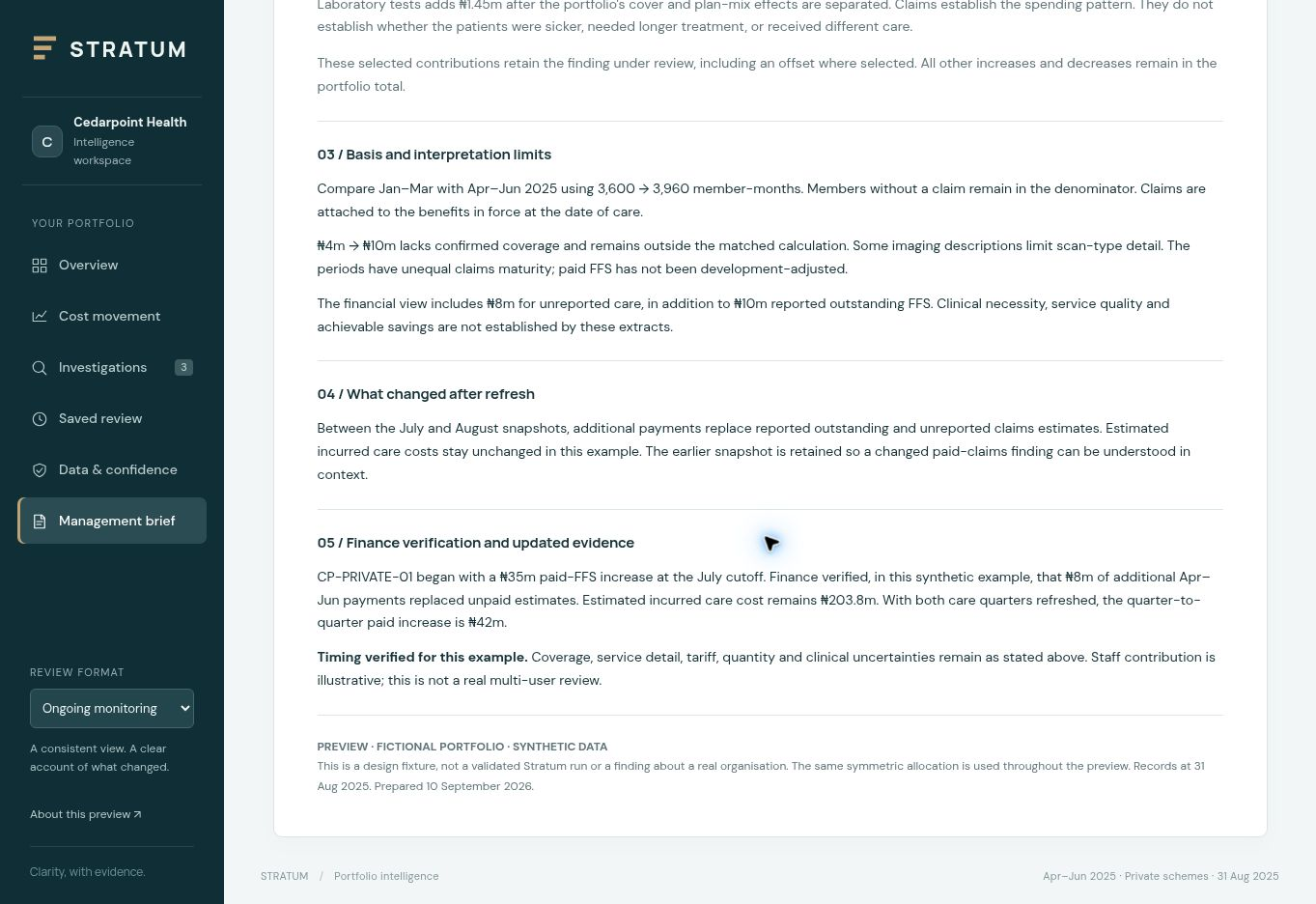
Bring the original question, current finding, illustrative Finance contribution and remaining uncertainties into the management brief. The displayed extract shows the new verification section and its interpretation limits.
The earlier July account remains available in the demonstration. Staff contributions are illustrative.
Working alongside your systems
Build on the information you already have.
Begin with the management questions and the records already available. Agree how definitions, evidence and review responsibilities fit your organisation.
Recurring use is the delivery direction. Shared review records, refreshes and system connections are established through the agreed implementation. See product maturity and demonstration details.
A management conversation
Start with what your team needs to see.
In a 30-minute walkthrough, explore the relevant parts of the HMO preview and discuss what would be needed to assess fit with your organisation’s records. No dataset is needed.